

Mr Dickens and the Mystery at Fort House
Louisa May Investigates: Book One
‘A stolen document. A famous author. A young maid with everything to lose.’
Seventeen-year-old Louisa May has just lost her job as a London housemaid when she is offered a fresh start by the celebrated Inspector Henry Hedge: five guineas to work undercover in the household of Charles Dickens to hunt down a thief. A sensitive document has been stolen from the great author’s study, and now he fears it could be used to ruin his career.
Louisa travels with the Inspector to Broadstairs, where Dickens has rented the cliff top Fort House for an extended seaside family holiday, and takes up her position.
Dickens is charming but volatile, his wife Catherine isolated and unhappy, and every member of the household seems to have something to hide.
As Louisa is drawn deeper into the mystery, she begins to suspect that the missing document is only just the beginning. Soon she finds herself trapped in a web of deception and must learn all the tricks of detection if she’s to uncover the truth.
York Gate, Broadstairs (left) circa 1890, Library of Congress Photochrom Print Collection
The idea behind the book
Mr Dickens and the Mystery at Fort House is inspired in part by Charles Dickens’ long-standing love for Broadstairs, ‘one of the freshest and free-est little places in the world.’
He first visited in 1837, as a young man on the cusp of fame, when Broadstairs was still a small fishing village. He immediately set his sights on Fort House, high on the cliff above the main bay, eventually renting it for several months in 1850 and 1851.

Fort House, pictured above circa 1840. Source: 1949 pamphlet Broadstairs during the time of Charles Dickens, printed by East Kent Times.
‘I love Broadstairs…
because it is quiet
and I can think here
and dream like a GIANT!’
Charles Dickens, writing from Fort House, October 1850
The Pilgrim Letters of Charles dickens
Vol 6, p184

It was here in Fort House, in his ‘airy nest’, that Dickens completed David Copperfield, and wrote his ode to Broadstairs, Our English Watering Place. Dickens made his last recorded visit to the town in 1862, staying one night with his friend the novelist Wilkie Collins, who’d rented Fort House for the summer.

Fort House became known locally as Bleak House – possibly as early as 1857 – although the novel of the same name wasn’t written there. In the early 21st century, it was run as a hotel and wedding venue, with a smuggler’s museum in the basement.
Visitors could look around Dickens’ old study and when I first went there in the autumn of 2017, I found dozens of admiring letters in the drawers of what was said to have been Dickens’ desk. A few years later, I saw the desk for sale in a junk shop in Margate.

Bleak House is now a private home, with a public tearoom, Haversham & Cratchit, and it hosts regular community events including a farmers’ market and the annual Broadstairs BookFest.

Dickens House Museum

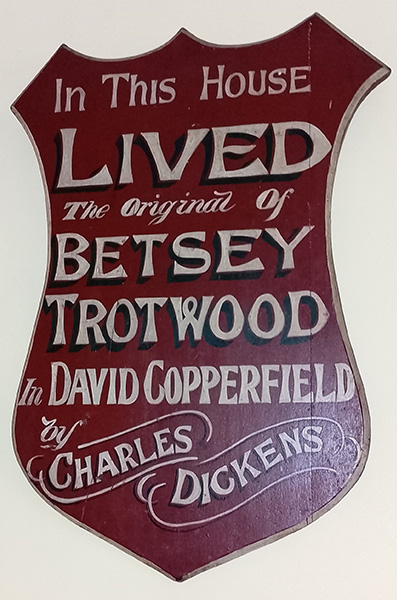
Dickens House Museum is housed in a cottage that belonged to Mary Pearson Strong, the inspiration for Betsey Trotwood in David Copperfield. She’s one of Dickens’ most successful female characters (and my grandmother’s favourite).
I’ve been a volunteer guide at the museum for the past four years, welcoming visitors from all over the world, many of whom have made a pilgrimage to be here.
Dickens’ son Charley fondly remembered having tea and cake with Mary Pearson Strong, and her determination to stop donkeys passing in front of her cottage – just like Betsey Trotwood.
The museum, which opened in 1973, is home to Dickens’ travelling writing box, as well as his mahogany sideboard and a collection of prints by H K Browne (Phiz).
Dickens wrote over 600 letters from Broadstairs, a place he often headed to either to work or for family holidays.
‘Today is one of the most wonderful and charming days I ever saw – the air so brisk and bracing as it is nowhere but at Broadstairs – the Channel so busy and alive with shipping as it is nowhere but off Broadstairs – the hotel so cosy and like a private house as it is nowhere but in Broadstairs – everything as nothing is out of Broadstairs. Veeve la Broadstairs!’
– Letter to his friend and illustrator John Leech, October 1849, while staying at the Albion Hotel (now the Royal Albion Hotel).
The museum is open Wednesday to Sunday, 1pm to 4pm, 1st April – 1st November
Female Detectives
Mr Dickens & the Mystery at Fort House is also inspired by the long and complex history of female private detectives, whose stories can be found in Private Inquiries.
Scotland Yard hired women to help solve crimes from at least the 1850s, often servants or former servants. While the job was frowned upon for women, senior detectives like Inspector Charles Frederick Field knew that women could infiltrate the domestic sphere far more easily than men.
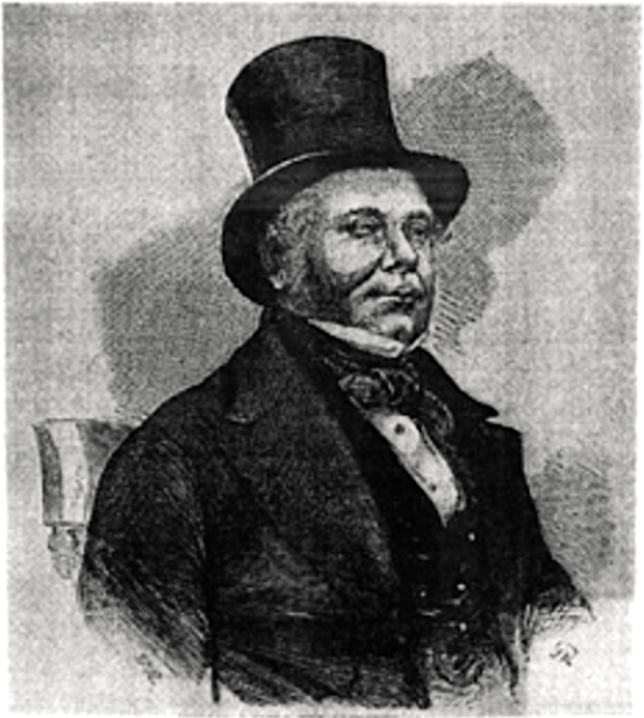
Inspector Field. Source: Wiki Commons
Field became a Private Inquiry Agent in 1852, and had been friends with Dickens for several years. He inspired the figure of Inspector Bucket in Bleak House, and Dickens praised him as ‘discretion itself’.
If a sensitive document had gone missing from Dickens’ study at Fort House, then Inspector Field would have been the ideal person to help. He was also known for hiring women to assist in his investigations….
